
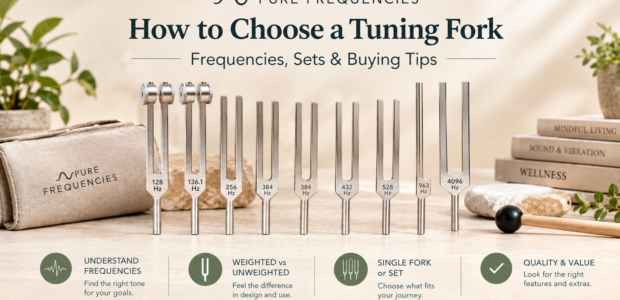

Choosing a tuning fork can be confusing when you first start shopping. There are different frequencies, weighted and unweighted designs, individual forks and multi-fork sets, and manufacturers often describe each frequency in different ways.
The good news is that you don’t need to understand every frequency before buying your first tuning fork.
A better approach is to start with how you plan to use it, then consider the frequency, fork design, number of forks, and overall quality.
In this guide, we’ll explain how to choose a tuning fork without getting lost in complicated frequency charts or marketing claims.
Affiliate Disclosure: Some links on DisOffers360 are affiliate links. If you make a purchase through one of these links, we may earn a commission at no additional cost to you. Our editorial content and recommendations are not affected by these commissions.
How to Choose a Tuning Fork: Start With Your Intended Use
Before comparing frequencies, think about what you actually want from the instrument.
Some people are interested in tuning forks for meditation or sound-focused practices. Others want to explore physical vibration through weighted forks. Some simply want to experiment with different tones and learn how tuning forks work.
Your intended use can help narrow down your options.
For example:
- Want to explore physical vibration? Look at weighted tuning forks.
- Interested primarily in sound and tone? Consider unweighted forks.
- Want several options in one purchase? A tuning fork set may make more sense.
- Know that you want one particular frequency? A single fork may be enough.
- Completely new to tuning forks? A beginner-friendly set can provide more flexibility.
There isn’t one universally “best” tuning fork. The right choice depends on what you want to learn, hear, feel, or incorporate into your routine.
What Does the Frequency of a Tuning Fork Mean?
A tuning fork’s frequency is measured in Hertz (Hz).
In simple terms, Hertz tells you how many vibrations occur per second. A 128 Hz tuning fork vibrates 128 times per second, while a 432 Hz fork vibrates 432 times per second.
Pure Frequencies currently sells forks across a fairly wide range, including 68.05 Hz, 128 Hz, 136.1 Hz, 256 Hz, 384 Hz, 432 Hz, 512 Hz, 528 Hz, 963 Hz and 4096 Hz.
The important thing for a beginner is that a higher number doesn’t automatically mean a better tuning fork.
Different frequencies produce different pitches and are used in different ways. Instead of asking, “Which frequency is best?” it’s usually more useful to ask:
“Which frequency fits what I’m trying to do?”
That’s a much more practical starting point.
Weighted vs Unweighted Tuning Forks
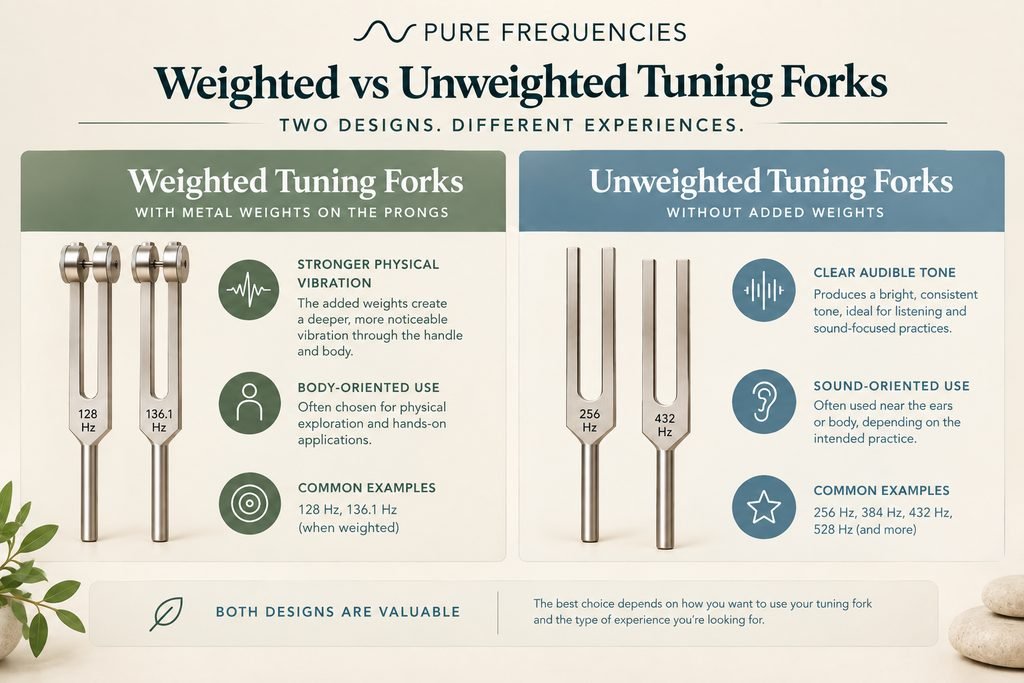
One of the most important decisions when choosing a tuning fork is whether you want a weighted or unweighted design.
What is a weighted tuning fork?
Weighted tuning forks have additional weights attached to the ends of their prongs.
They are commonly designed to produce a stronger physical vibration that can be felt through the handle or stem when the fork is activated and applied appropriately.
What is an unweighted tuning fork?
Unweighted tuning forks don’t have those additional weights.
They are generally used more for their audible tone and can be held near the ears or body depending on the particular practice and manufacturer’s instructions.
Pure Frequencies itself describes weighted forks as more body-oriented tools and unweighted forks as more sound-oriented tools.
Which one should you choose?
A simple way to think about it is:
| If you’re interested in… | Consider |
|---|---|
| Physical vibration | Weighted |
| Audible tones | Unweighted |
| Meditation and sound-focused practices | Unweighted |
| Exploring body-based vibration | Weighted |
| Having both options | A set containing both |
If you aren’t sure, a set containing both types can give you more flexibility.
For example, Pure Frequencies’ current Harmony Set contains 128 Hz and 136.1 Hz weighted forks plus 256 Hz and 384 Hz unweighted forks.
Single Tuning Fork or Tuning Fork Set?
The next question is whether you should buy one fork or several.
When a single tuning fork makes sense
A single fork can be a good choice if:
- You already know which frequency interests you.
- You want to learn the basics before buying more.
- You have a specific sound or tone in mind.
- You want to keep the initial purchase simple.
Buying one fork also lets you learn how to activate and use it without having to learn several frequencies at once.
When a tuning fork set makes sense
A set can make more sense if:
- You want to compare different frequencies.
- You want both weighted and unweighted options.
- You are interested in building a broader practice.
- You don’t yet know which individual frequency you prefer.
Pure Frequencies currently offers four main tuning-fork sets: Harmony, Grounded, Serenity and Angel.
For someone completely new to the category, a set can therefore be more versatile than buying several individual forks separately.
How to Choose Between Common Tuning Fork Frequencies
You don’t need to memorize every frequency, but it helps to understand some of the commonly encountered options.
128 Hz
Pure Frequencies currently lists its 128 Hz fork as the “Muscle & Joint Reset” fork. It is a weighted fork.
If you’re specifically interested in exploring a lower-frequency weighted fork, 128 Hz is one of the company’s prominent options.
136.1 Hz
Pure Frequencies calls its 136.1 Hz fork the “Earth OM” fork and offers it as a weighted fork.
It is also included in the Harmony and Serenity sets.
256 Hz
The company’s current collection describes its 256 Hz fork as “Mental Clarity.”
It is an unweighted fork and appears in both the Harmony and Serenity sets.
384 Hz
Pure Frequencies currently lists 384 Hz as its “Tension Release” fork.
It is also one of the unweighted forks included in the Harmony Set.
432 Hz
The 432 Hz fork is listed by Pure Frequencies as its “Natural Tuning” fork.
It is one of the two frequencies in the Grounded Set.
528 Hz
Pure Frequencies currently calls its 528 Hz fork the “Love Frequency” fork.
It is included in the Serenity Set.
963 Hz and higher frequencies
The current Pure Frequencies collection also includes higher-frequency options such as 963 Hz and 4096 Hz.
These are quite different from the lower-frequency weighted forks, so they’re worth considering separately rather than assuming that a higher frequency is automatically a better beginner choice.
Should You Buy a Specific Frequency Because of Its Marketing Claims?
This is an important question.
You’ll find many websites making very specific claims about what individual frequencies can do for the body, nervous system, emotions, sleep, pain or other conditions.
Those claims should be treated carefully.
A tuning fork is an instrument that produces a specific sound and vibration. Marketing descriptions are not the same thing as independent clinical evidence.
For example, Pure Frequencies’ own product pages make various wellness and physiological claims about individual frequencies. Those are manufacturer claims, so we shouldn’t present them as established medical facts.
For shopping purposes, it’s safer to focus on:
- the frequency itself
- whether the fork is weighted
- how you intend to use it
- construction quality
- what comes with the product
- the manufacturer’s instructions
- return and warranty terms
That gives you a much more useful basis for comparison.
What Should You Look for in a Quality Tuning Fork?
Frequency isn’t the only thing that matters.
1. Construction
Look for clear information about the material and construction of the fork.
Pure Frequencies, for example, describes its forks as precision-machined aluminum and states a calibration tolerance on its product pages.
You don’t necessarily need the most expensive fork available, but the manufacturer should provide enough information for you to understand what you’re buying.
2. Frequency accuracy
If a fork is sold as a specific frequency, you want the manufacturer to explain how accurately it is calibrated.
This becomes particularly important when you’re comparing multiple forks or building a set around specific tones.
3. Included accessories
Check whether the purchase includes an activator, mallet, carrying case, instructions or other accessories.
A cheaper fork isn’t necessarily the better value if you have to purchase essential accessories separately.
4. Instructions
Beginners should look for clear instructions on:
- how to strike the fork
- what type of activator to use
- where the fork can be safely applied
- how to store it
- how to care for the instrument
5. Return policy
If you’ve never used a tuning fork before, you may not know which sound or design you prefer.
A clear return policy can therefore be valuable when comparing products.
What Is the Best Tuning Fork for a Beginner?
There isn’t one answer for everyone.
If you already know that you want a particular frequency, starting with one individual fork may be the simplest approach.
If you’re completely new and want to experiment with different frequencies and both weighted and unweighted designs, a set may provide more flexibility.
For example, the current Pure Frequencies Harmony Set combines four forks:
- 128 Hz weighted
- 136.1 Hz weighted
- 256 Hz unweighted
- 384 Hz unweighted
That makes it a particularly broad configuration for someone who wants to explore both types of tuning forks.
If you’d like a more detailed comparison of the main Pure Frequencies sets, see our guide:
Pure Frequencies Harmony vs Serenity vs Grounded: Which Set Is Right for You?
And if you are completely new to tuning forks, our beginner’s guide covers the basics:
Pure Frequencies Tuning Forks: 7 Essential Tips for Beginners
A Simple Tuning Fork Buying Checklist
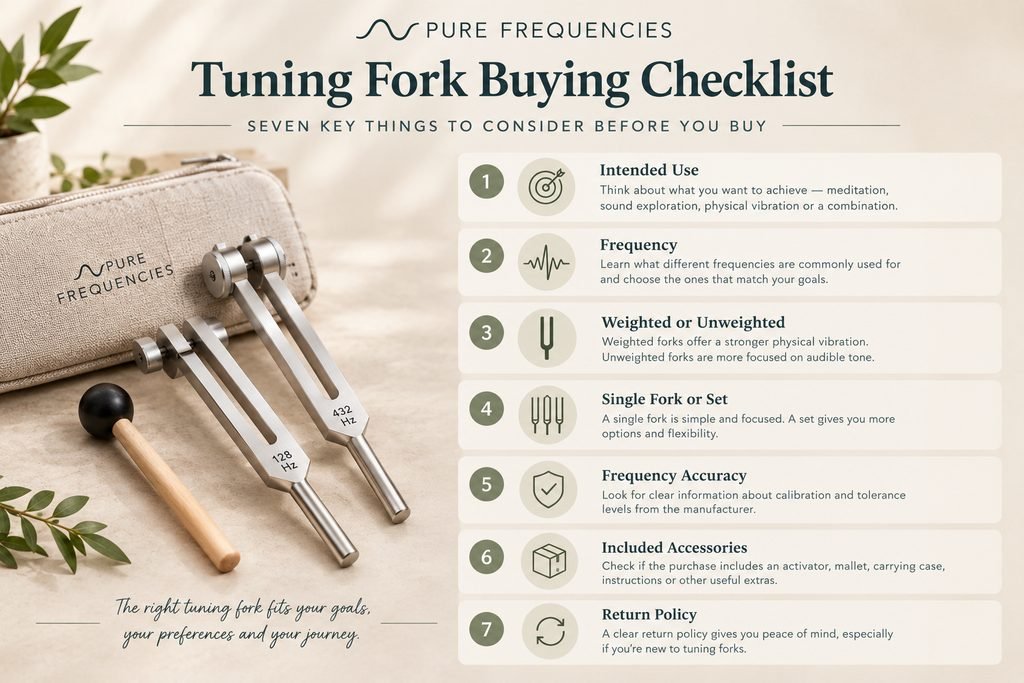
Before purchasing, ask yourself these seven questions:
1. What do I want to use it for?
Start with your intended use rather than a frequency chart.
2. Do I want physical vibration or primarily sound?
That can help you decide between weighted and unweighted designs.
3. Do I already know which frequency I want?
If yes, a single fork may be enough.
4. Would several frequencies be more useful?
If you’re experimenting, consider a set.
5. Is the fork accurately calibrated?
Look for information about frequency accuracy.
6. What accessories are included?
Check for an activator, case and instructions.
7. What happens if I change my mind?
Check the retailer’s return policy before buying.
This simple checklist can eliminate a lot of unnecessary guesswork.
Where to Find Pure Frequencies Coupons
If you’ve decided which Pure Frequencies tuning fork or set you’re interested in, it’s worth checking for an active offer before completing your purchase.
You can visit our dedicated page for current offers:
Pure Frequencies Coupons, Promo Codes & Deals
Promotions, coupon codes, prices and availability can change, so always verify the final offer and terms on the retailer’s website before purchasing.
Final Thoughts
Learning how to choose a tuning fork doesn’t require memorizing every frequency.
Start with your intended use. Then look at whether you want a weighted or unweighted fork, whether a single fork or set makes more sense, and whether the manufacturer provides enough information about frequency accuracy, construction and usage.
If you’re comparing Pure Frequencies products specifically, the current range includes individual forks as well as Harmony, Grounded, Serenity and Angel sets, giving beginners several ways to approach the category.
The best starting point is the one that matches what you actually want to explore, rather than the one with the biggest list of marketing claims.
Frequently Asked Questions
What is the best tuning fork frequency for beginners?
There isn’t one universally best frequency for every beginner. Your intended use, preferred sound and whether you want weighted or unweighted vibration are more useful starting points.
Should I buy a weighted or unweighted tuning fork?
Choose based on how you want to use it. Weighted forks are designed for stronger physical vibration, while unweighted forks are generally more focused on audible tone.
Is it better to buy a tuning fork set?
A set can be useful if you want to experiment with multiple frequencies or both weighted and unweighted forks. A single fork may be better if you already know which frequency you want.
What does Hz mean on a tuning fork?
Hz stands for Hertz and describes the number of vibrations per second. For example, a 432 Hz fork vibrates at 432 cycles per second.
Are higher-frequency tuning forks better?
Not necessarily. A higher frequency simply represents a different rate of vibration and produces a different pitch. The right choice depends on your intended use and preferences.
How do I know if a tuning fork is good quality?
Look for clear information about frequency accuracy, construction materials, included accessories, instructions, and the retailer’s return policy.
Can I use a tuning fork for medical treatment?
A tuning fork should not be treated as a substitute for professional medical care. Manufacturer wellness claims should also not automatically be interpreted as established medical evidence.