
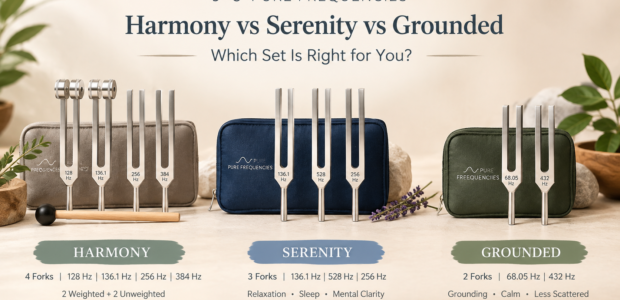

Choosing a tuning fork set can be confusing when several options use different frequencies and are designed around different routines.
If you’re comparing the Pure Frequencies Harmony vs Serenity vs Grounded sets, the biggest differences are the number of forks, the frequencies included, whether the forks are weighted or unweighted, and how Pure Frequencies positions each set.
This guide breaks down the three options side by side so you can understand what makes each one different before deciding which set fits your routine.
Affiliate Disclosure: Some links on DisOffers360 are affiliate links. If you make a purchase through one of these links, we may earn a commission at no additional cost to you. Our editorial content and recommendations are not affected by these commissions.
Pure Frequencies Harmony vs Serenity vs Grounded at a Glance
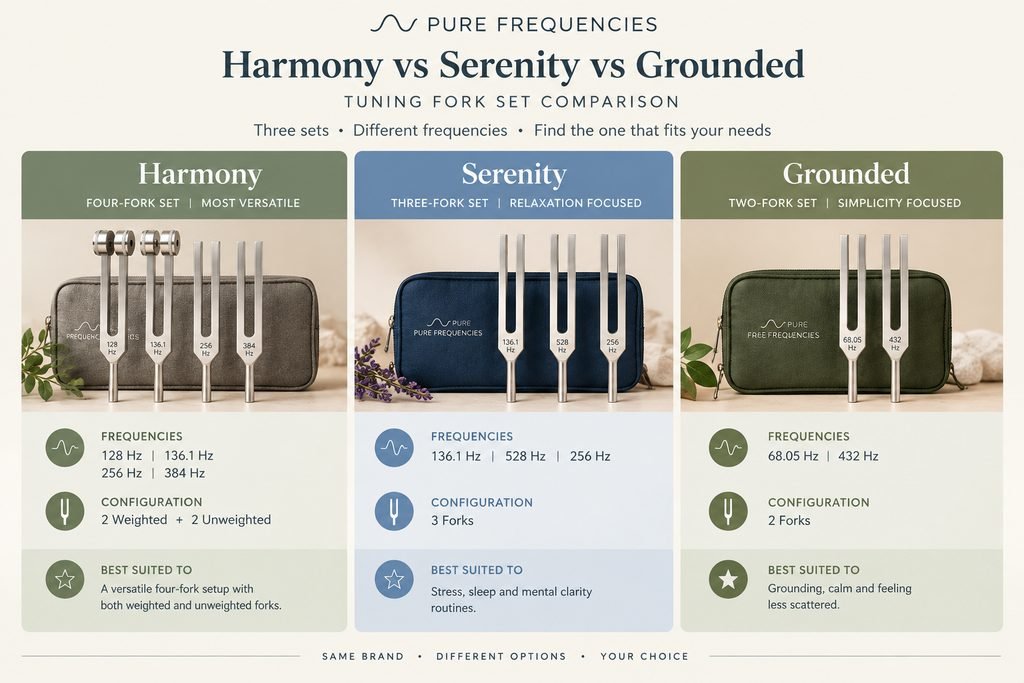
Here is the simplest way to compare the three sets:
| Set | Frequencies | Configuration | Best suited to |
|---|---|---|---|
| Harmony | 128 Hz, 136.1 Hz, 256 Hz, 384 Hz | 2 weighted + 2 unweighted | A versatile four-fork setup |
| Serenity | 136.1 Hz, 528 Hz, 256 Hz | Three-fork set | Relaxation, sleep and calming routines |
| Grounded | 68.05 Hz, 432 Hz | Two-fork set | A simpler, grounding-focused setup |
The frequency configurations above match Pure Frequencies‘ current product and collection information.
The important thing to remember is that there isn’t one objectively “best” set for everyone. The better choice depends on whether you want maximum versatility, a three-frequency relaxation-oriented setup, or a simpler two-frequency option.
Pure Frequencies Harmony Set
The Harmony Set is the largest of these three options, with four tuning forks:
- 128 Hz — weighted
- 136.1 Hz — weighted
- 256 Hz — unweighted
- 384 Hz — unweighted
Pure Frequencies describes the weighted forks as being used with direct contact and the unweighted forks as being used around the body or ears. The company’s current Harmony product page also describes the set as combining physical and mental applications.
Why choose Harmony?
The biggest advantage of Harmony is variety.
You get both weighted and unweighted forks, along with four different frequencies. That gives you more flexibility to experiment with different ways of using the set.
For someone who doesn’t yet know which frequencies or techniques they’ll prefer, that versatility can be appealing.
The four-fork configuration also makes Harmony a logical option if you want one set that covers several types of tuning-fork routines rather than buying individual forks separately.
Harmony may be a good fit if:
- You want the most versatile option of these three.
- You like having both weighted and unweighted forks.
- You want four different frequencies to work with.
- You’re interested in exploring different tuning-fork techniques.
Pure Frequencies currently identifies Harmony as its four-frequency set, with the 128 Hz and 136.1 Hz forks weighted and the 256 Hz and 384 Hz forks unweighted.
Pure Frequencies Serenity Set
The Serenity Set contains three frequencies:
- 136.1 Hz
- 528 Hz
- 256 Hz
Pure Frequencies positions this set around relaxation-oriented routines, including stress, sleep and mental clarity.
Compared with Harmony, Serenity is a little more straightforward. Instead of four frequencies and both weighted and unweighted configurations, you’re working with three frequencies built into one smaller set.
Why choose Serenity?
Serenity may appeal to someone who wants a focused three-fork setup rather than the broader configuration of Harmony.
The set combines 136.1 Hz, 528 Hz and 256 Hz, and Pure Frequencies presents those frequencies as part of a sequence aimed at calming, emotional and mental routines.
If your main interest is creating a simple evening or relaxation routine, Serenity may make more sense to you than purchasing the larger Harmony set.
Serenity may be a good fit if:
- You prefer a three-fork setup.
- Your interest is primarily relaxation-oriented routines.
- You want 136.1 Hz, 528 Hz and 256 Hz together.
- You don’t specifically need the four-fork configuration of Harmony.
Pure Frequencies Grounded Set
The Grounded Set takes a different approach.
It contains just two frequencies:
- 68.05 Hz
- 432 Hz
Pure Frequencies describes 68.05 Hz as its low-frequency grounding option and 432 Hz as a complementary frequency within the set. The current product page describes the set as a simpler two-frequency approach.
Why choose Grounded?
The main attraction is simplicity.
Instead of choosing among four frequencies, you’re working with only two. That can make the learning curve feel less complicated for someone who wants a straightforward routine.
The 68.05 Hz and 432 Hz combination is also distinct from the frequencies included in Harmony and Serenity.
Grounded may be a good fit if:
- You prefer a simple two-fork setup.
- You don’t want to start with a larger collection.
- You’re specifically interested in the 68.05 Hz and 432 Hz combination.
- You prefer having fewer frequencies to learn and experiment with.
Pure Frequencies currently lists Grounded as a two-frequency set containing 68.05 Hz and 432 Hz.
Harmony vs Serenity vs Grounded: What’s the Biggest Difference?
The easiest way to understand the three sets is to think about flexibility versus focus.
Harmony: the most versatile option
Harmony gives you four frequencies and both weighted and unweighted forks.
That makes it the broadest setup of the three.
If you’re not sure what you’ll eventually want from a tuning-fork collection, having four different frequencies gives you more room to explore.
Choose Harmony if versatility is your priority.
Serenity: a focused three-fork setup
Serenity reduces the number of frequencies to three: 136.1 Hz, 528 Hz and 256 Hz.
It’s a good middle ground between the larger Harmony configuration and the minimalist Grounded setup.
Choose Serenity if you want a focused three-frequency routine.
Grounded: the simplest setup
Grounded contains only 68.05 Hz and 432 Hz.
There are fewer forks to learn and fewer combinations to think about.
Choose Grounded if simplicity is your priority.
Which Pure Frequencies Set Is Best for a Beginner?
There isn’t a universal answer.
Instead, consider what you want from your first set.
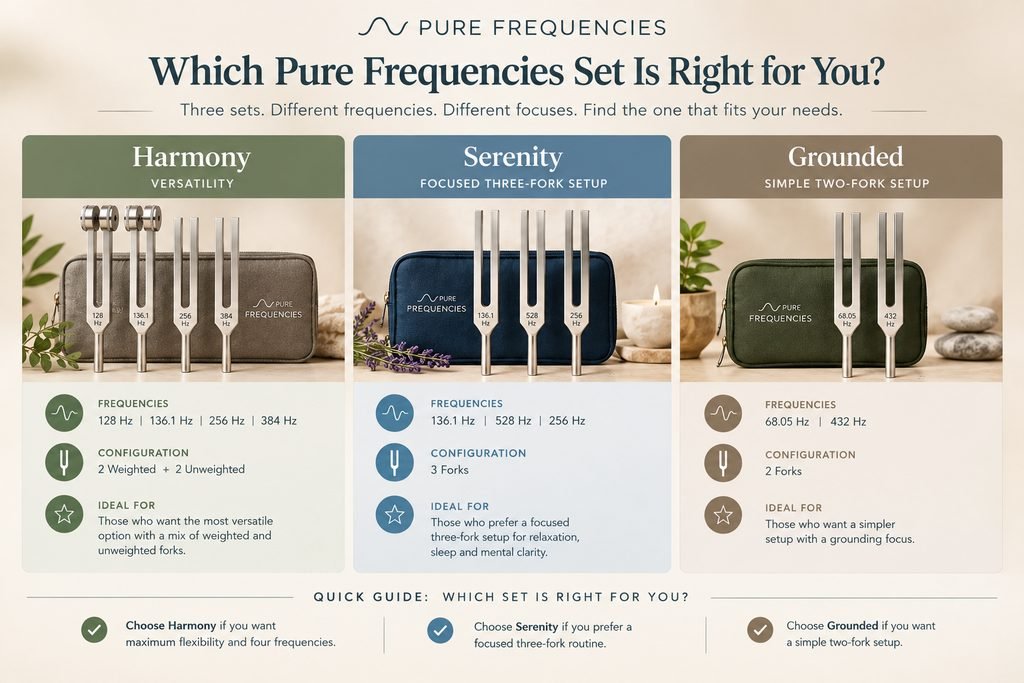
Choose Harmony if you want the most options
If you want to experiment with both weighted and unweighted tuning forks and don’t mind having four frequencies to learn, Harmony offers the broadest configuration.
Choose Serenity if you want a focused routine
If you’re more interested in a smaller set built around 136.1 Hz, 528 Hz and 256 Hz, Serenity gives you a straightforward three-fork configuration.
Choose Grounded if you want to keep things simple
If you would rather start with just two frequencies, Grounded is the simplest of these three options.
In short:
- Most versatile: Harmony
- Focused three-fork setup: Serenity
- Simplest two-fork setup: Grounded
That doesn’t mean one set is scientifically or objectively superior to the others. It simply reflects the differences in their configurations and how the manufacturer positions them.
Weighted vs Unweighted Tuning Forks
One of the most important differences to understand is the distinction between weighted and unweighted tuning forks.
Weighted forks have weights attached to the ends of the prongs. They generally produce a stronger, longer-lasting vibration and are commonly designed for direct-contact techniques.
Unweighted forks don’t have those weights and are commonly used as sound-oriented tools, including holding them near the body or ears.
Harmony is the only one of these three sets that combines both configurations: its 128 Hz and 136.1 Hz forks are weighted, while its 256 Hz and 384 Hz forks are unweighted.
If you’re new to tuning forks, our beginner’s guide explains the difference in more detail:
Pure Frequencies Tuning Forks: 7 Essential Tips for Beginners
What About the Pure Frequencies Angel Set?
Pure Frequencies also currently sells an Angel Tuning Fork Set, but it isn’t included in our main comparison because its configuration is quite different.
The Angel Set contains:
- 4096 Hz
- 4160 Hz
- 4225 Hz
Those frequencies make it a different proposition from Harmony, Serenity and Grounded.
If you’re specifically interested in higher-frequency tuning forks, the Angel Set may be worth researching separately rather than trying to compare it directly with the three sets in this guide.
How to Choose Between Harmony, Serenity and Grounded
Still unsure?
Use these questions as a quick checklist.
1. Do you want maximum flexibility?
Harmony is the obvious choice of the three because it contains four frequencies and combines weighted and unweighted forks.
2. Do you prefer a smaller three-fork collection?
Consider Serenity, with its 136.1 Hz, 528 Hz and 256 Hz configuration.
3. Do you want the simplest possible starting point?
Grounded has just two frequencies: 68.05 Hz and 432 Hz.
4. Do you already know which frequencies interest you?
If you already have a particular frequency in mind, compare the individual forks and sets rather than choosing based only on the number of forks.
5. Are you completely new to tuning forks?
Before buying, our beginner’s guide can help you understand frequencies, weighted versus unweighted forks and what to consider when choosing a set.
Pure Frequencies Tuning Forks: 7 Essential Tips for Beginners
Where Can You Find Pure Frequencies Coupons?
Once you’ve decided which set you’re interested in, it’s worth checking for an active discount before ordering.
DisOffers360 maintains a dedicated page for Pure Frequencies coupons, promo codes and deals, where we list available offers and savings opportunities.
[Check the latest Pure Frequencies Coupons, Promo Codes & Deals]
Because coupon availability, expiration dates and terms can change, always check the offer details before completing your purchase.
Final Thoughts
When comparing Pure Frequencies Harmony vs Serenity vs Grounded, the biggest difference isn’t simply the number of forks.
Each set takes a different approach.
Harmony gives you the broadest configuration, with four frequencies and both weighted and unweighted forks.
Serenity offers a more focused three-frequency combination of 136.1 Hz, 528 Hz and 256 Hz.
Grounded keeps things simple with just 68.05 Hz and 432 Hz.
For someone who wants flexibility, Harmony is the natural starting point. For someone who prefers a focused three-fork setup, Serenity may be more appealing. And if simplicity matters most, Grounded offers the least complicated configuration.
Before buying, compare the frequencies, understand the difference between weighted and unweighted forks, and think about how you actually plan to use your set.
And if you’re ready to purchase, check for current Pure Frequencies coupons and deals before you place your order.
Frequently Asked Questions
Is Harmony better than Serenity?
Not necessarily. Harmony contains four frequencies and both weighted and unweighted forks, while Serenity contains three frequencies. The better choice depends on which configuration fits your preferences.
What is the difference between Harmony and Grounded?
Harmony contains four frequencies — 128 Hz, 136.1 Hz, 256 Hz and 384 Hz — with both weighted and unweighted forks. Grounded contains two frequencies: 68.05 Hz and 432 Hz.
What is the difference between Serenity and Grounded?
Serenity contains 136.1 Hz, 528 Hz and 256 Hz, while Grounded contains 68.05 Hz and 432 Hz. Pure Frequencies positions Serenity around stress, sleep and related relaxation routines, while Grounded is presented as a simpler grounding-focused set.
Which Pure Frequencies set has weighted tuning forks?
Harmony includes weighted and unweighted forks. Its 128 Hz and 136.1 Hz forks are weighted, while its 256 Hz and 384 Hz forks are unweighted.
How many tuning forks are in each set?
Harmony has four forks, Serenity has three, and Grounded has two.
Does Pure Frequencies have other tuning fork sets?
Yes. In addition to Harmony, Serenity and Grounded, the current collection also includes the Angel Set, which contains 4096 Hz, 4160 Hz and 4225 Hz forks.
Where can I find Pure Frequencies discount codes?
You can check the latest Pure Frequencies coupons, promo codes and deals on DisOffers360 before purchasing. Offers can change, so verify the current terms and expiration information before checkout.